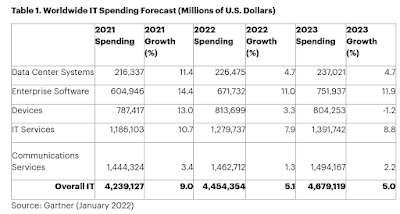
Many senior executives remain upbeat about the potential of a business technology investment to drive digital business growth. Worldwide information technology (IT) spending is projected to total $4.5 trillion in 2022 -- that's an increase of 5.1 percent over 2021, according to the latest market study by Gartner.
Despite the potential impacts of the COVID-19 pandemic and commercial disruption fueled by the Omicron variant, economic recovery with high expectations for digital market prosperity will continue to boost technology investments.
Hybrid Enterprise IT Market Development
"2022 is the year that the future returns for the CIO," said John-David Lovelock, vice president at Gartner. "They are now in a position to move beyond the critical, short-term projects over the past two years and focus on the long term."
Simultaneously, staff skills gaps, wage inflation, and the demand for digital transformation talent will push CIOs to rely more on consultancies and managed service firms to pursue their digital strategies.
Gartner forecasts that the IT services segment -- which includes consulting and managed services -- is expected to have the second-highest spending growth in 2022, reaching $1.3 trillion, and up 7.9 percent from 2021.
Strategic business and technology management consulting spending, specifically, is expected to grow 10 percent in 2022. Leading digital business strategy and IT systems integration firms will continue as the most likely trusted advisors by senior executives seeking guidance.
Through 2025, organizations will increase their reliance on external consultants, as the greater urgency and accelerated pace of change widens the gap between organizations’ digital business ambitions and their internal resources and capabilities, according to the Gartner assessment.
"This will be particularly poignant with cloud as it serves as a key element in achieving digital ambitions and supporting hybrid work,” said Lovelock.
Gartner expects the vast majority of large organizations to use external consultants to develop their hybrid cloud services strategy over the next few years, as more organizations struggle to find and retain skilled and experienced digital transformation talent.
In 2020, looking back within the enterprise application software market, the cloud computing services market became larger than the non-cloud software market for the first time, due in part to the ongoing coronavirus pandemic. This is also a key forward-looking trend.
Outlook for Hybrid IT Applications Growth
By 2025, Gartner expects the cloud sector to be double the size of the non-cloud market. Cloud computing is responsible for nearly all of the 11 percent spending growth within the enterprise software segment in 2022, as organizations focus on upgrading their software stack to software-as-a-service (SaaS) to support continued flexibility and agility.
That said, I anticipate more CIOs and CTOs will also invest the time and effort to develop comprehensive plans to support flexible working models for the significant growth of large enterprise distributed workforce initiatives. Demand will include on-premises and cloud-based IT services.
Moreover, the adoption of secure digital workspace platforms will help to enable the ongoing transition to an Anywhere Workspace digital business model, where knowledge workers and field employees seek solutions that improve their online productivity and overall user experience.